
Same Azure tools. Different compliance pressure. If I had to sum this up in one line, it’s this: healthcare is shaped by Article 9 health data controls, while finance is shaped by retention, payment controls, and Article 22 decision rules.
Here’s the short version:
- Healthcare puts more weight on patient data limits, region lock-down, and access audit trails.
- Finance puts more weight on transaction logging, AML/KYC record retention, and explainable automated decisions.
- Both use Azure Policy, Entra ID, Purview, Key Vault, Defender for Cloud, and Sentinel.
- The main design split is not the toolset. It’s how each sector enforces access, keys, deletion, and logging.
- One Azure setting matters in both sectors: Key Vault Purge Protection. Once enabled, it can’t be turned off, so it sits at the center of retention-versus-erasure conflicts.
A few facts shape the whole article:
- GDPR Article 9 gives health, genetic, and biometric data tighter treatment than standard personal data.
- Finance teams often add PCI DSS, SOC 2, ISO 27001, and AML/KYC rules on top of GDPR.
- AI use differs by sector: healthcare needs strong records of what data the system touched, while finance needs decision logging and a path to contest high-impact automated outcomes.
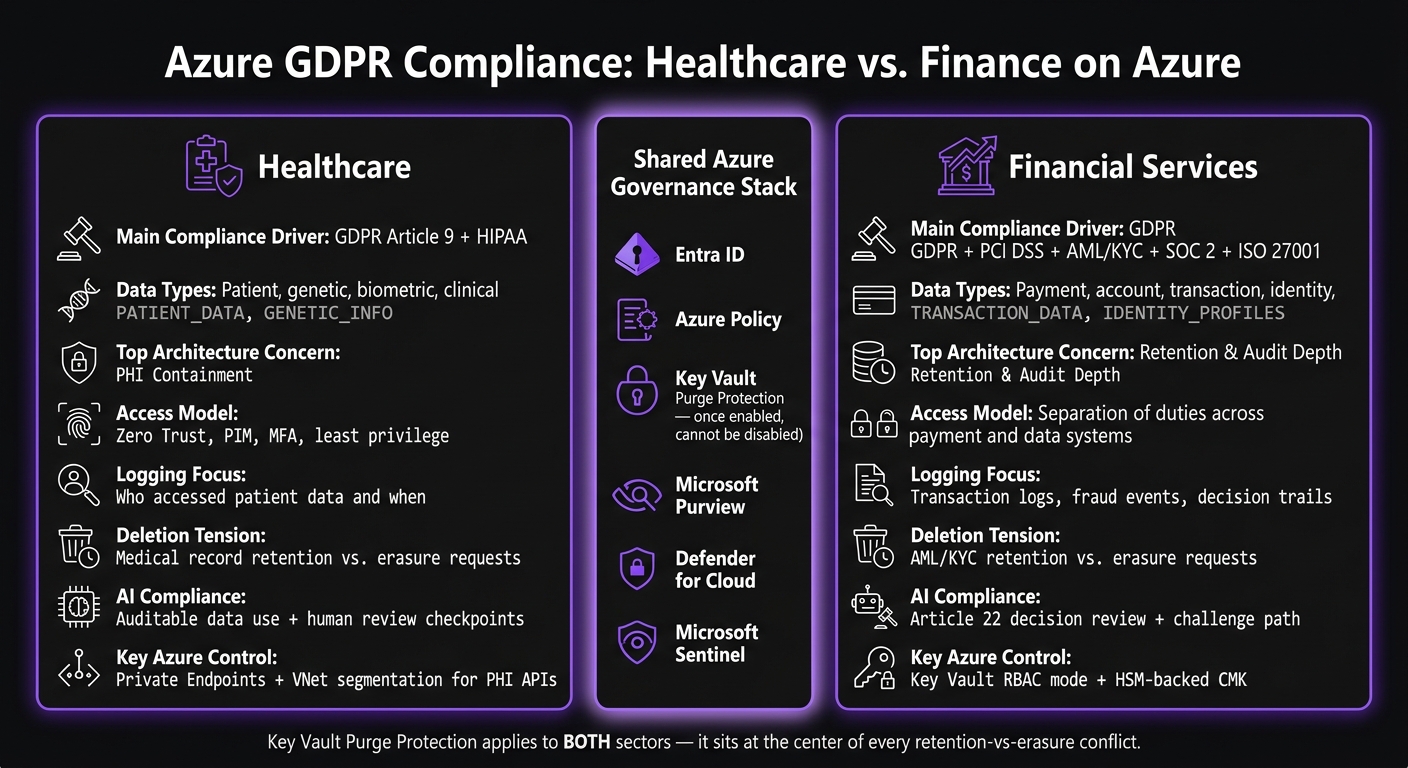
Azure GDPR Compliance: Healthcare vs Finance Side-by-Side
Protecting privacy in Microsoft Azure: GDPR, Azure Policy updates
Quick Comparison
| Area | Healthcare on Azure | Finance on Azure |
|---|---|---|
| Main compliance driver | GDPR Article 9, HIPAA | GDPR + PCI DSS, AML/KYC, SOC 2, ISO 27001 |
| Data focus | Patient, genetic, biometric, clinical data | Payment, account, transaction, identity, profiling data |
| Top architecture concern | PHI containment | Retention and audit depth |
| Access model | Tight PHI access with PIM, MFA, least privilege | Separation of duties across payment and data systems |
| Logging focus | Who accessed patient data and when | Transaction logs, fraud events, decision trails |
| Deletion tension | Medical record retention vs. erasure requests | AML/KYC retention vs. erasure requests |
| AI compliance pressure | Auditable data use and human review | Article 22 decision review and challenge path |
So if you’re planning Azure GDPR controls, I’d keep the rule simple: don’t copy one sector’s policy set into the other. The platform may match, but the data risk, retention pressure, and audit needs do not.
Healthcare on Azure: GDPR Controls for Patient and Clinical Data
Healthcare puts Azure under tighter rules around data minimization, regional isolation, and auditability because this data falls into a special category. Under GDPR, patient records, genetic data, and biometric identifiers are special-category data under Article 9, which means stricter controls than standard personal data. In U.S. healthcare, that same data is often also PHI under HIPAA.
Healthcare Data Risks and the GDPR Articles That Apply
Healthcare systems need to limit access, prove who accessed what, and control how long data stays in the system. That turns privacy by design, residency limits, and deletion rules into core Azure architecture decisions.
Azure Policy Patterns for Healthcare Workloads
| Control Area | Azure Implementation | Regulatory Alignment |
|---|---|---|
| Identity & Access | Entra ID, PIM, MFA, least-privilege RBAC | GDPR access control, HIPAA technical safeguards |
| Data Discovery | Microsoft Purview with PHI/PII sensitivity labels | GDPR data mapping |
| Encryption | TLS in transit, AES-256 at rest, Key Vault RBAC mode | GDPR encryption, HIPAA, HITRUST |
| Network Isolation | Private Endpoints, Private Link, VNet segmentation | GDPR privacy by design, HIPAA transmission security |
| Retention & Deletion | Azure Key Vault Purge Protection and soft-delete | Medical record retention, GDPR erasure requests |
| Threat Detection | Defender for Cloud, Microsoft Sentinel | GDPR security of processing, HIPAA audit controls |
Azure Key Vault Purge Protection is a big deal here. Once you turn it on, you can't turn it off, which makes it the main control when record retention duties collide with erasure requests [2]. In plain English: if a hospital must keep some records for legal or care reasons, but also has to handle deletion requests, this setting sits right in the middle of that tension.
Policy as code should also lock sensitive data to approved Azure regions and stop it from moving outside approved regions and networks. That's how teams avoid drift over time, especially when environments grow and more people touch the platform.
These controls work best when Azure Policy, identity controls, and data classification work together. If one piece is weak, the whole setup starts to wobble.
Where AppStream Studio Fits in Regulated Healthcare AI

Regulated healthcare AI needs architecture that deals with GDPR and HIPAA from day one, not later when the system is already live. AppStream Studio builds AI agents for healthcare organizations on the Microsoft stack, using RAG pipelines and semantic search so agents stay grounded in controlled, auditable data sources. Every deployment includes audit trails, escalation rules, and human-in-the-loop checkpoints, creating a clear record of what the agent accessed, when, and why [3].
Finance uses much of the same Azure base, but the focus moves to payment data, transaction logs, and tighter audit retention.
sbb-itb-79ce429
Financial Services on Azure: GDPR Controls for Customer, Payment, and Transaction Data
Finance starts from the same Azure base as healthcare, but AML/KYC retention rules, payment integrity, and automated decisions change how policy needs to work.
Financial Data Risks and GDPR Requirements in Practice
Financial services deal with a different GDPR mix. On top of core customer data, teams also handle payment, account, transaction, AML/KYC, and profiling data. They also need to line that up with PCI DSS, SOC 2, and ISO 27001.
The biggest tension is retention vs. erasure. AML and KYC rules may require institutions to keep certain records for audit and supervisory use even after a customer invokes the right to erasure [4]. That’s why Key Vault Purge Protection is a core control. It stops encryption keys from being permanently deleted during required retention windows [2].
Finance also leans hard on AI for fraud detection, credit underwriting, and risk scoring. Under GDPR, automated decisions that create legal or other major effects on individuals require transparency and a path for people to challenge the outcome [4]. In practice, that shapes how AI systems are built, documented, and backed by a DPIA.
Cross-border transfers are another major risk area. Financial institutions working across the U.S. and Europe must make sure customer data moving between regions follows GDPR transfer safeguards. That makes Azure region restrictions and data residency policies non-negotiable [4].
Those legal pressures turn into direct Azure policy choices around access, keys, logging, and residency.
Azure Policy Patterns for Financial Workloads
| Control Area | Azure Implementation | Regulatory Alignment |
|---|---|---|
| Identity & Access | Entra ID, MFA, RBAC with separation of duties across data and payment systems | GDPR access control, SOC 2, PCI DSS |
| Encryption | AES-256 at rest, TLS in transit, CMK with HSM backing | PCI DSS, ISO 27001 |
| Key Management | Key Vault Purge Protection, RBAC mode | GDPR retention, AML/KYC obligations |
| Data Discovery | Microsoft Purview, PII/PCI labeling | GDPR data mapping, PCI DSS |
| Logging & Audit | Azure Monitor, Sentinel, Key Vault logs | SOC 2, supervisory audits |
| Network Isolation | Private Endpoints, Private Link, VNet segmentation for transaction systems | GDPR privacy by design, PCI DSS |
| Governance | Azure Policy, CIS benchmarks, Audit mode, then Enforce mode | GDPR by design, ISO 27001 |
Key Vault RBAC mode helps split management from secret access. In RBAC mode, subscription owners can manage the vault, but they can’t read the secrets stored inside it.
For AI-driven workflows such as fraud analytics, governance should require full request logging so the setup can support a DPIA [4][3].
Where AppStream Studio Fits in Financial Services AI
These controls matter most in AI workflows that need to be auditable from day one. AppStream Studio builds AI agents for AML/KYC workflows and risk scoring, built for regulated AML/KYC and risk-scoring workflows with auditability and observability [1].
Healthcare vs. Finance: Azure GDPR Differences That Change Architecture
The same Azure controls don't land the same way in healthcare and finance. The tools may match, but the risk model doesn't. So the next layer isn't about adding more controls. It's about changing which controls matter most.
These are the sector differences that most often shape Azure architecture.
Comparison Table: GDPR Obligations by Sector and Azure Implementation
| GDPR Dimension | Healthcare on Azure | Financial Services on Azure |
|---|---|---|
| Primary Compliance Pressure | GDPR Art. 9 special-category data + HIPAA | PCI DSS, AML/KYC, SOC 2, ISO 27001 layered on GDPR |
| Data Residency | Clinical data locked to approved regions | GDPR transfer safeguards apply when data moves across regions |
| Encryption Standard | AES-256 + CMK; PHI APIs behind Azure API Management | AES-256 + HSM-backed CMK; PCI DSS drives stricter key management |
| Identity Pattern | Patient-centric Zero Trust; PIM for PHI API access | Function-separated by role; PIM for privileged operations |
| Key Vault Deletion Controls | Purge Protection aligns with clinical record retention windows | Purge Protection prevents premature deletion during AML/KYC retention periods |
| Logging Focus | Clinical audit trails showing who accessed patient data and when | Transaction logs and fraud telemetry |
| AI Risk Profile | Clinical documentation and care coordination | Fraud detection, credit underwriting, and risk scoring with Article 22 risk |
How Sector Differences Change Azure Design Decisions
In healthcare, the main concern is PHI containment. That pushes teams toward Private Endpoints and VNet segmentation so PHI APIs stay off the public internet. Microsoft Purview then classifies data and applies sensitivity labels at ingestion [3].
In finance, the pressure shifts to audit depth and retention integrity. Azure RBAC separates management-plane and data-plane access. And Purge Protection on Key Vault becomes a hard architecture call, not a nice-to-have, because once you turn it on, you can't reverse it [2].
AI changes shape too. In healthcare, AI has to guard clinical context. In finance, AI has to explain decisions. That means financial AI needs full decision logging and clear challenge paths to meet Article 22 requirements.
Those differences lead straight into the controls both sectors still share.
Shared Azure Governance and Final Takeaways
Shared Controls Both Sectors Need
The stack stays the same. The policy pattern changes.
Both sectors lean on the same Azure governance stack: Entra ID, Azure Policy, Key Vault, Defender for Cloud, Sentinel, and Purview. Key Vault stores secrets and keeps admin access separate from secret access. Purview classifies sensitive data across data lake and SQL workloads. A well-built landing zone speeds up delivery and gives teams better visibility. A weak landing zone pushes risk into every pipeline.
The tools may be shared, but the rules can't be copy-pasted from one sector to another. Each one still needs sector-specific policy assignments, custom alerting logic, and guardrails tuned to its actual risk model.
| Control Category | Shared Baseline | Sector-Specific Priority |
|---|---|---|
| All Controls | Entra ID, Key Vault, Defender for Cloud, Sentinel, Purview | Healthcare: PHI containment and clinical audit trails; Finance: AML/KYC retention and Article 22 decision logging |
Conclusion: Match Policies to Your Risk Model, Not a Checklist
That’s the core difference between healthcare and finance on Azure: same platform, different guardrails.
GDPR on Azure is not one-size-fits-all. Healthcare and financial services use the same base toolset, but their data types, workflows, and regulatory layers don't line up neatly. The teams that handle this well treat policy as code: programmatic rules with automatic enforcement and audit-ready output. Sector-specific guardrails are not optional add-ons - they’re the line between real compliance and paper compliance. Match Azure Policy to the risk model, not the industry label.
FAQs
Which Azure controls should each sector prioritize first?
Both sectors should start with core governance and security controls: RBAC, Cost Management, Network Watcher, and Microsoft Defender for Cloud.
Then map sector-specific mandates - such as HIPAA in healthcare or PCI-DSS and SOC 2 in finance - to Azure Policy definitions and deploy them through Management Groups. That setup helps enforce guardrails like disk encryption, resource tagging, regional restrictions, zero-trust identity controls, and encryption with Azure Key Vault.
How do GDPR erasure requests work with required record retention?
In regulated fields like healthcare and finance, GDPR erasure requests don't always lead to full deletion. If a law says certain records must be kept, that legal duty usually takes priority over the right to erasure.
The usual approach is simple in principle, even if the work behind it can be strict: keep only the records the law requires, store them in a secure and compliant state, limit who can access them, and maintain clear audit logs that show why the data was kept.
When does Article 22 affect AI systems in finance?
The available information does not cover Article 22 or explain its direct effect on AI systems in finance.
Instead, it talks about AppStream Studio’s approach to compliance. The focus is on frameworks and standards like HIPAA, PCI DSS, SOC 2, and broad GDPR requirements.
It also points to the Azure-based tools used to support that work, including Azure Policy, Azure Arc, and Microsoft Purview.


