
Modernizing legacy systems with RAG pipelines is now a practical solution for enterprises stuck with outdated infrastructure. These pipelines use AI to retrieve and generate relevant information, bridging the gap between rigid legacy systems and modern workflows without requiring a full system replacement.
Key Takeaways:
- RAG pipelines combine retrieval mechanisms (to access data) and generation models (like GPT-4) to deliver accurate, real-time responses.
- They address common legacy challenges like siloed data, lack of APIs, and batch-only workflows.
- Measurable results include improved accuracy (up to 91%), faster response times (e.g., from hours to seconds), and cost reductions (33% savings on API usage).
How It Works:
- RAG pipelines use adapters and orchestration layers (via tools like LangChain) to connect AI with legacy systems.
- Advanced techniques like hybrid retrieval, document chunking, and caching improve accuracy while reducing costs.
- They ensure compliance in regulated industries by logging retrieval steps and citing sources.
Performance Highlights:
- Latency improvements: Processes reduced from hours to seconds.
- Accuracy boost: Up to 92% correctness in complex queries.
- Cost efficiency: API costs dropped by 33% in some implementations.
RAG pipelines are transforming industries like healthcare, finance, and logistics by enabling legacy systems to support AI-driven solutions. This approach is efficient, scalable, and effective for modernizing old infrastructure while maintaining compliance and reducing costs.
Your RAG Is Broken - Production RAG Architecture Nobody Teaches (2026)
sbb-itb-79ce429
Architectural Patterns for RAG in Legacy Systems
Integrating Retrieval-Augmented Generation (RAG) into legacy systems effectively hinges on thoughtful architectural design. The chosen approach impacts how well the pipeline manages the quirks of older systems, its responsiveness, and the level of effort required when those systems inevitably evolve.
Retrieval-Augmented API Orchestration
Legacy systems often rely on outdated and rigid interfaces like SOAP services, WCF endpoints, or proprietary APIs - none of which are ideal for conversational AI. To bridge this gap, introducing a lightweight adapter layer between the RAG pipeline and the legacy backend is key. This adapter ensures consistent schemas, unified authentication, and robust error handling. Essentially, it shields the orchestration layer from the unpredictability of legacy systems [3].
The orchestration layer, typically built using frameworks like LangChain or LlamaIndex, translates natural language queries into actionable commands - such as SQL queries, API calls, or structured payloads for mainframes [2][8]. For example, implementing a stability adapter on a COBOL system improved accuracy from 61% to 91% and reduced latency from 4.8 seconds to 1.9 seconds - a 60% improvement [3].
"Legacy systems can absolutely support modern AI - but only if you isolate their instability." - Himanshu Singh, ML Consultant [3]
Once API orchestration is in place, the focus shifts to tackling unstructured and interconnected documentation that defines many legacy environments.
Document-Centric RAG for Legacy Artifacts
Legacy systems are often accompanied by a maze of technical documentation - COBOL copybooks, stored procedures, HL7 message specifications, and data dictionaries - that is rarely searchable. Standard RAG methods struggle with these deeply interlinked documents. For instance, a single COBOL program might reference numerous copybooks, making a flat retrieval approach insufficient.
Hybrid-multihop retrieval offers a solution. This method begins with an initial retrieval pass, followed by an LLM-driven extraction of entities - such as program names or data structure identifiers - which are then used for a second, more targeted search [4]. In March 2026, Laurent Guizard tested this approach using "CardDemo", an AWS sample mainframe COBOL application. The multi-hop pipeline outperformed standard GraphRAG models, successfully answering 15 out of 47 complex architectural questions [4]. When chunking legacy documents, recursive character splitting - which respects sections and paragraph boundaries - consistently delivers better results than fixed-size chunking [6].
"The retrieval strategy should fit the data - not the other way around." - Laurent Guizard, Principal Solutions Architect [4]
Building on these retrieval methods, a modernization facade can further simplify AI integration by abstracting legacy data.
Modernization Facade with Incremental RAG Layers
The modernization facade approach treats the RAG layer as a permanent abstraction, not just a temporary workaround. By mirroring legacy data into a vector store, it offloads search and retrieval tasks from the legacy infrastructure. This allows the legacy system to continue operating while the AI layer handles advanced processing [1].
This staged approach to integration is particularly beneficial for enterprises. Teams can start with a basic RAG setup - covering core retrieval and generation - and gradually add advanced features like access control, guardrails, audit logging, and monitoring [7]. Additionally, a canonical agent-schema within the facade ensures seamless communication between legacy systems and modern AI agents. This design future-proofs the integration, enabling eventual replacement of legacy systems without disrupting the AI layer [5]. To maintain efficiency, event-driven ETL pipelines can reduce data sync times from 24 hours to under 5 minutes [3].
These architectural patterns demonstrate how RAG can modernize legacy systems, improving their speed, accuracy, and scalability while ensuring long-term adaptability.
Performance Metrics and Outcomes of RAG Pipelines
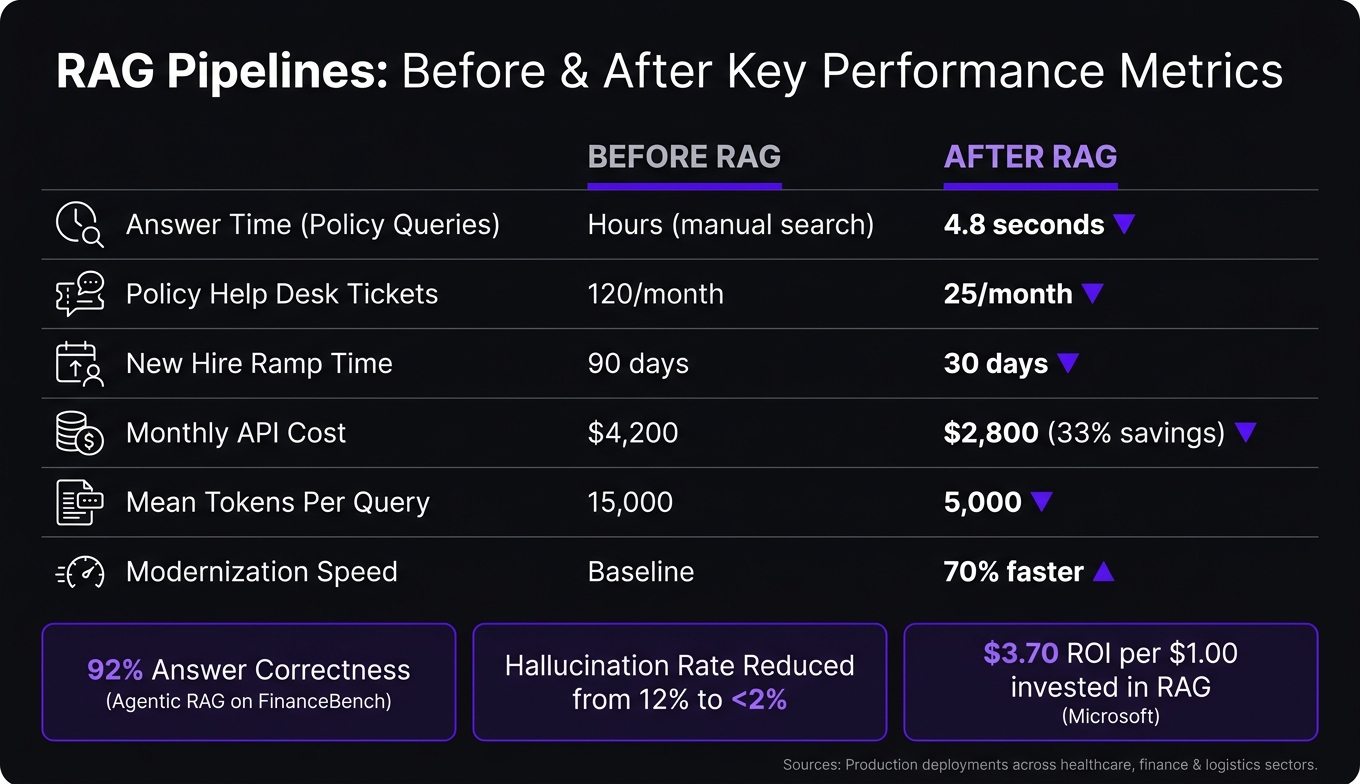
RAG Pipelines in Legacy Systems: Before vs After Key Metrics
RAG pipelines, as outlined earlier, bring measurable improvements in performance. Key metrics like latency, accuracy, and cost demonstrate their impact, often driving leadership to invest in these solutions. Let’s break down how these pipelines deliver results.
Latency and Scalability in Synchronous Integrations
One of the standout benefits of RAG pipelines is speed. Processes that used to take hours of manual effort are now completed in seconds. For example, a deployment aimed at policy queries reduced the average response time from several hours to just 4.8 seconds. Additionally, new employee onboarding times dropped from 90 days to 30 days, thanks to a RAG-powered knowledge base. This change also led to an 80% drop in policy-related help desk tickets - from 120 to just 25 per month [12].
"Our new hires used to spend weeks figuring out basic processes. Now they ask the AI assistant and get the answer with a link to the source document. It's like giving everyone a senior colleague who knows everything." - James Crawford, VP of Engineering [12]
To handle latency, strategies like multi-level caching, asynchronous batch processing, and fallback mechanisms across multiple providers are employed [9]. Scalability is another area where RAG pipelines shine. By analyzing patterns, it was discovered that 70–90% of logic in legacy integrations overlaps, meaning that what initially appeared to be 700 unique integrations could be reduced to just 12 reusable patterns. This consolidation slashes modernization timelines by nearly 40% [10].
Accuracy and Error Reduction in Integration Workflows
While traditional RAG pipelines work for basic tasks, legacy systems often require a more advanced approach - agentic RAG. These models can decide when to dig deeper or retrieve additional content, delivering far better results. A study by Microsoft Corporation (Suresh et al., 2026) showed that agentic RAG pipelines achieved 92% answer correctness on FinanceBench, compared to just 24% for traditional RAG [13]. On the WixQA benchmark, agentic RAG reached a factuality score of 0.96, a 13% improvement over standard retrieval methods [13].
Another critical factor is reranking. Simply relying on raw vector similarity isn’t enough. Adding a neural reranker - like Claude - after the initial search step improves retrieval accuracy and answer quality by 40% [12]. This post-processing step ensures higher-quality results before the data reaches the language model.
Cost Efficiency of RAG Deployments
Cost savings are often the tipping point for leadership approval. In one production environment, each error cost $14 in escalation time. With 6,000 queries processed daily, the financial impact was impossible to ignore [14].
"The number that got leadership to fund rebuild 4 wasn't RAGAS - it was $14 × 6,000 queries/day." - Mohit Verma, AI/ML Engineer [14]
Switching to a dynamic Top-K strategy - retrieving fewer chunks for simple queries and more for complex ones - reduced monthly API costs from $4,200 to $2,800, a savings of 33%. This approach also cut the average tokens per query from 15,000 to 5,000 [14]. The table below highlights the transformation in key metrics:
| Metric | Before RAG | After RAG |
|---|---|---|
| Answer time (policy queries) | Hours (manual search) | 4.8 seconds [12] |
| Policy help desk tickets | 120/month | 25/month [12] |
| New hire ramp time | 90 days | 30 days [12] |
| Monthly API cost | $4,200 | $2,800 [14] |
| Mean tokens per query | 15,000 | 5,000 [14] |
| Modernization speed | Baseline | 70% faster [11] |
Using semantic chunking instead of fixed-token splitting further improves precision, increasing retrieval accuracy from 0.23 to 0.54. This reduces the number of irrelevant chunks passed to the language model, directly lowering token usage and cost [14]. These advancements pave the way for even more improvements in retrieval, caching, and feedback mechanisms.
Optimization Strategies for RAG in Legacy Contexts
The performance improvements discussed earlier don’t happen by chance. They’re the result of intentional decisions across every layer of the pipeline - how data is indexed, how responses are cached, and how systems adapt to their own errors.
Improving Information Retrieval and Indexing
Strong retrieval design is at the heart of RAG accuracy. In fact, the quality of retrieval often outweighs the importance of the language model itself. As Emanuel Mallia, Data & AI Architect, explains:
"The retrieval is the hard part, not the generation. Most teams over-invest in prompt engineering and under-invest in chunking, indexing, and evaluation." [17]
One effective strategy is hybrid search, which combines dense vector search with sparse keyword search (like BM25). This approach has been shown to improve recall by 15–25% compared to vector-only methods in enterprise environments [16].
The way documents are split for indexing also plays a critical role. Parent-child chunking is particularly effective: smaller "child" chunks enable precise vector matches, while the larger "parent" chunks provide the language model with the full context it needs [17]. For documents heavy on tables, converting the tables into natural language summaries before indexing significantly improves semantic search results [15][16].
Another high-impact improvement is adding a cross-encoder re-ranker after the initial retrieval step. This technique can drastically reduce hallucination rates. For example, one financial services system combined source citation enforcement with a retrieval score threshold of 0.78, cutting hallucination rates from 12% to under 2% [15].
These retrieval optimizations also set the stage for more efficient caching strategies.
Caching and Precomputation Techniques
In legacy systems with high traffic, relying on real-time computation for every query can lead to skyrocketing costs and slower response times. Instead, shifting computation to the data ingestion phase can make a huge difference.
For instance, precomputing embeddings during data ingestion removes the need to generate them during live queries. Similarly, pre-summarizing structured data like tables into natural language gives the embedding model clean, semantic text to work with [16]. In systems with complex relationships, such as COBOL programs referencing shared copybooks, precomputing these relationships as metadata enables multi-hop reasoning without the need for additional live retrieval passes [4].
At the query level, caching plays a key role. Reusing system prompts and large documents can reduce costs by 50–80% [16]. Semantic caching, which reuses responses for similar queries, is another effective strategy. One COBOL-based RAG system implemented these techniques and saw response latency drop from 4.8 seconds to 1.9 seconds - a 60% improvement. It also reduced index refresh delays from 24 hours to less than 5 minutes [3].
Monitoring and Feedback Loops
Optimizing retrieval and caching is just one part of the equation. Continuous monitoring ensures the system maintains high-quality performance over time. RAGOps, a practice focused on tracking metrics like retrieval quality drift, query costs, and latency SLAs, is becoming a standard for production pipelines [18].
A good starting point is creating a golden dataset - a set of 50–100 carefully curated question-and-answer pairs with annotated source chunks. Every pipeline change should be tested against this dataset before deployment [15][16]. Many teams are now using LLM-as-judge frameworks, where high-reasoning models (e.g., Claude 3.5 Sonnet) evaluate outputs for accuracy and relevance [4][17]. Setting automated quality gates, such as requiring a faithfulness score above 0.85, can turn evaluation into an automated process [17].
In industries like healthcare and financial services, human-in-the-loop (HITL) reviews remain critical for cases where confidence scores are borderline. These aren’t just edge cases - they’re often the moments where errors could lead to regulatory or financial consequences [15]. Attaching detailed metadata (e.g., timestamps, source IDs, approval levels) to every indexed chunk ensures these reviews are both auditable and compliant with regulations [3].
Case Studies in Regulated and High-Throughput Environments
These strategies have shown real-world success in regulated and high-demand settings. By using RAG (Retrieval-Augmented Generation) pipelines, organizations across various industries have modernized older systems, achieving measurable improvements in both performance and compliance.
Healthcare: Integrating EHR and Billing Systems
Schmitt-Thompson Clinical Content (STCC) implemented a HIPAA-compliant RAG system to convert proprietary clinical guidelines into an AI-supported triage pipeline between 2025 and 2026. This system used structured indexing to maintain the integrity of clinical decision trees. When tested on 329 clinical scenarios, it achieved over 95% CRD (Clinical Relevance Determination) with no hallucinations [21].
"We approached this as a safety program first. If we can't measure accuracy against nurse-validated scenarios, we shouldn't claim progress." - Matthew Thompson, Product Manager, STCC / TAG [21]
Cascade, a regional health system, introduced a FHIR-native RAG workflow to automate prior-authorization processes across 14 hospitals. Using Azure AI Document Intelligence and a LangChain-powered assistant to summarize clinical narratives and route requests, the system reduced median turnaround times from 9.4 days to just 11 hours. Impressively, 78% of prior-authorization requests were processed entirely without human involvement [22].
"Our UM nurses are finally doing the clinical work they trained for instead of shuffling faxes. The patient experience improvement alone has paid for the engagement five times over." - Operations Director, Regional Health System [22]
Meanwhile, AppStream Studio developed a scheduling platform for a health system with over 100 clinics. Built on a legacy EMR with HL7 bi-directional syncing, the platform cut appointment booking times to just 1 minute and 37 seconds. It now handles more than 250,000 appointments annually with 99.9% uptime, all while retaining the existing EMR infrastructure [20].
Financial Services: Risk and Policy Analysis
Morgan Stanley launched its "AI @ Morgan Stanley Assistant" in September 2023, equipping 16,000 financial advisors with a RAG system powered by GPT-4. This system searches through 100,000 proprietary documents and a million pages of institutional knowledge, linking responses to their original sources and clarifying whether the information is current or historical. Advisors now save an estimated 20–45 minutes daily on information retrieval [23].
"Financial advisors spend a significant amount of their time searching for information rather than advising clients. The knowledge exists... The challenge is connecting advisors to the right knowledge at the right moment." - Jeff McMillan, Head of Analytics, Data, and Innovation, Morgan Stanley [23]
In the FinTech space, Amazon's Finance Technology team tackled the complexity of handling multi-turn regulatory inquiries across jurisdictions in near real time. Their RAG system, built on Amazon Bedrock and OpenSearch Serverless, incorporated Claude 3.5 Haiku for query expansion and parallel retrieval, cutting latency from 10 seconds to under 2 seconds. Amazon Bedrock Guardrails ensured PII and sensitive financial data were filtered out, while OpenTelemetry provided complete audit trails [19].
These advancements in financial services have set the stage for addressing challenges in logistics and field service operations.
Field Service and Logistics: Improving Scheduling Systems
Field service environments demand quick and accurate access to data from legacy dispatch systems, equipment manuals, and service records. AppStream Studio developed Aiventic.ai, an AI assistant for field technicians, to address this need. The tool integrates with legacy scheduling systems to deliver instant access to service histories, parts information, and diagnostic guidance. The aim? To minimize repeat visits by equipping technicians with the right information upfront.
This approach utilized hierarchical document navigation, which improved retrieval quality by 5.9 times while only slightly increasing token costs [13]. In high-throughput settings where multiple queries are handled simultaneously, this balance between quality and cost is essential.
Conclusion and Key Takeaways
Summary of RAG Benefits in Legacy Contexts
Across sectors like healthcare, financial services, and field operations, the results are clear: RAG pipelines deliver measurable outcomes without requiring a complete overhaul of existing systems. With about 70% of corporate data stuck in siloed systems [8], RAG provides a practical solution to access and utilize this untapped information.
The performance gains are impressive. Well-optimized pipelines can bring hallucination rates down to below 3% [24], while agentic retrieval methods show a 5.9x improvement in recall compared to single-shot searches [13]. Additionally, RAG avoids the high expense of fine-tuning large models - costs that can climb into tens of thousands of dollars per iteration - while ensuring data remains current [25]. Microsoft’s analysis highlights an ROI of $3.70 for every $1.00 invested in generative AI programs that include retrieval pipelines [25]. For industries with strict regulations, RAG also offers the advantage of keeping proprietary data secure within controlled environments while providing built-in source citations, which are essential for audits and compliance [25].
The Future of RAG in Legacy System Modernization
Agentic RAG represents the next step forward, moving beyond static retrieve-then-generate workflows toward more dynamic systems. These autonomous agents can plan, retrieve, verify, and synthesize information in iterative cycles. On benchmarks like BRIGHT, agentic tools - using functions such as search, find, and open - achieved a recall rate of 49.6%, significantly outperforming single-shot retrieval’s 8.41% [13]. As these systems continue to evolve, the gap in performance is expected to grow even wider.
Microsoft is already shaping this future through tools like Azure AI Foundry Agent Service and Semantic Kernel, which enable multi-agent architectures for real-time collaboration with legacy data sources [26]. The global RAG market is set for substantial growth, projected to rise from $1.94 billion in 2025 to $9.86 billion by 2030, with a CAGR of 38.4% [25]. For organizations still relying on legacy infrastructure, this trend signals a clear opportunity to gain a competitive edge.
"Agentic RAG aims to automate that hand-off, providing an LLM with the precise information it needs at exactly the right moment." - Microsoft [26]
FAQs
Do I need to replace my legacy system to use RAG?
No, you don’t need to replace your legacy systems to implement Retrieval-Augmented Generation (RAG). Instead, RAG pipelines can be added on top of your existing infrastructure, allowing you to introduce AI capabilities without interrupting your current workflows. By leveraging adapters or agents, your data can be accessed through APIs or middleware, making the integration process smoother. AppStream Studio focuses on connecting RAG pipelines with legacy systems using the Microsoft AI stack, ensuring everything is seamlessly integrated and ready for production.
How do RAG pipelines connect to systems with no modern APIs?
RAG pipelines can work with systems that lack modern APIs by employing alternative methods to extract legacy data. These include direct database connections, scheduled flat-file exports, change data capture (CDC) from database logs, or, as a last resort, UI automation or RPA (Robotic Process Automation). Once the data is extracted, it’s converted into formats suitable for AI processing, stored in a vector database, and kept up-to-date in near real-time using ETL or CDC processes. This approach ensures that legacy workflows continue to operate smoothly, even if there are retrieval failures.
How do you ensure RAG answers remain compliant and auditable?
Ensuring compliance and auditability in Retrieval-Augmented Generation (RAG) pipelines demands specific architectural controls. These controls are designed to treat automated retrieval as formal data access. Here are some key practices to implement:
- Granular logging: Keep detailed records, including user information, timestamps, document IDs, chunk IDs, and sensitivity scopes. This level of detail ensures a clear audit trail.
- Authorization-first retrieval: Apply filters at the vector database level using metadata to ensure only authorized data is retrieved.
- Retrieval proof: Securely store cryptographic hashes of any injected context. This provides verifiable evidence of retrieval actions.
AppStream Studio specializes in creating secure, compliant AI agents that align with rigorous standards like HIPAA and SOC 2, ensuring robust data handling and privacy.


