
If your identity alert lacks context, your team loses time. My take: a production-ready RAG pipeline should pull sign-ins, device state, prior incidents, access policy, and playbook context at alert time - while keeping retrieval tied to the analyst’s access.
Here’s the article in plain English:
- I see RAG as an evidence layer, not a SIEM replacement
- I’d use event-driven processing so identity events trigger retrieval within seconds, not after a batch run
- I’d limit RAG to high-risk identity events like risky sign-ins, privilege changes, OAuth consent abuse, and lateral movement signals
- I’d keep retrieval access-aware with OAuth 2.0 Token Exchange (RFC 8693) and strict document filtering
- I’d secure the flow with Managed Identities, Private Endpoints, VNet integration, encryption, and audit logs
- I’d treat prompt injection, cross-tenant leakage, over-retrieval, and embedding inversion as top risks
- I’d measure time to decision, groundedness, confidence calibration, manual review volume, cost per request, and cache hit rate
A few numbers stand out. The article cites $0.00376 per event, 4.1 seconds average processing time, and caching that can cut API cost by up to 70% and latency by 75%. It also notes that analysts spend close to one-third of their time on false positives.
In other words: the point isn’t just to generate a summary. It’s to give analysts a short, cited case brief based on live identity evidence, with logs that show who asked, what was retrieved, and why the system responded the way it did.
| Area | What I’d focus on |
|---|---|
| Triggering | Only send high-risk identity events into retrieval |
| Retrieval | Pull recent sign-ins, device history, incidents, KBs, and playbooks |
| Access control | Enforce analyst entitlements before search starts |
| Security | Lock down network paths, secrets, prompts, and audit trails |
| Data handling | Redact regulated data before chunking and embedding |
| SOC metrics | Track latency, cost, retrieval quality, and analyst impact |
If you want the short version, it’s this: RAG helps identity detection when it adds evidence fast, stays inside access limits, and gives analysts output they can verify.
Reference architecture for a RAG-based identity detection pipeline
Core components: from telemetry to investigation output
The pipeline starts at the edge, with telemetry from Entra ID, Microsoft 365, and Microsoft Sentinel. Those signals are then normalized into a canonical schema that includes subject ID, event type, timestamp, source, and any available confidence scores or correlation IDs.
Next, Azure Event Hubs or Azure Event Grid manages real-time ingestion and trigger routing. Identity telemetry is stored in Azure Data Lake or Log Analytics. Logs, prior cases, KB articles, and playbooks are indexed in Azure AI Search for hybrid retrieval, which combines dense vector similarity with sparse BM25 lexical matching. Use semantic search to find similar past cases, and lexical matching when you need exact IDs and IPs.
Semantic Kernel coordinates the flow between the retrieval layer and Azure OpenAI, which handles embedding generation and response generation. The system then produces a grounded investigation brief with:
- A summary
- Source documents
- Suggested actions
The next step is deciding which events should kick off retrieval.
How event triggers drive retrieval and generation
Once the architecture is in place, only high-risk identity events should trigger retrieval. That means RAG should run only for events such as risky sign-ins, impossible travel, privilege escalation, and anomalous OAuth consent grants.
When one of those events fires, the pipeline launches a retrieval query across the vector index. It pulls the account’s recent sign-in history, any open or recently closed incidents tied to that identity, matching KB articles, and the relevant playbook section for the detected MITRE ATT&CK technique. Azure OpenAI then turns that context into a concise investigation summary with suggested response actions, grounded in what was actually retrieved. The goal is simple: bring back only the evidence needed to decide whether the alert is explainable or should be escalated.
One design point matters a lot here: authorization must happen before retrieval. If an analyst with limited scope triggers a retrieval, the pipeline should show only the documents that analyst is allowed to access. Use OAuth 2.0 Token Exchange (RFC 8693) so retrieval stays within the requesting user’s entitlements [5].
Comparison: rule-based correlation vs. RAG-based enrichment
Rules are fast at spotting known patterns. RAG adds the context that helps an analyst make sense of them. At the investigation layer, the split looks like this:
| Capability | Rule-Based Correlation | RAG-Based Enrichment |
|---|---|---|
| Logic basis | Static thresholds and predefined patterns | Semantic similarity and LLM reasoning over retrieved context |
| Data scope | Structured fields in a single log source | Logs, prior cases, KB articles, and playbooks |
| Investigation guidance | Fixed playbooks and static SIEM queries | Generated investigation summaries and guidance |
| Adaptability | Requires manual rule updates for new patterns | Improves as embeddings and indexed documents are updated |
| Auditability | Explicit logic gates and event ledgers | Document citations and traceable outputs |
| Primary failure mode | False negatives on novel or low-and-slow attacks | Hallucinations and prompt injection if retrieval is uncontrolled |
Rules surface the alert. RAG fills in the case context. Use rules when the pattern is known and clear. Use RAG when the alert is ambiguous and the signal is there, but the story behind it needs context.
sbb-itb-79ce429
Data to Defense: Generative AI and RAG Powering Real-Time Threat Response
Security, compliance, and governance requirements
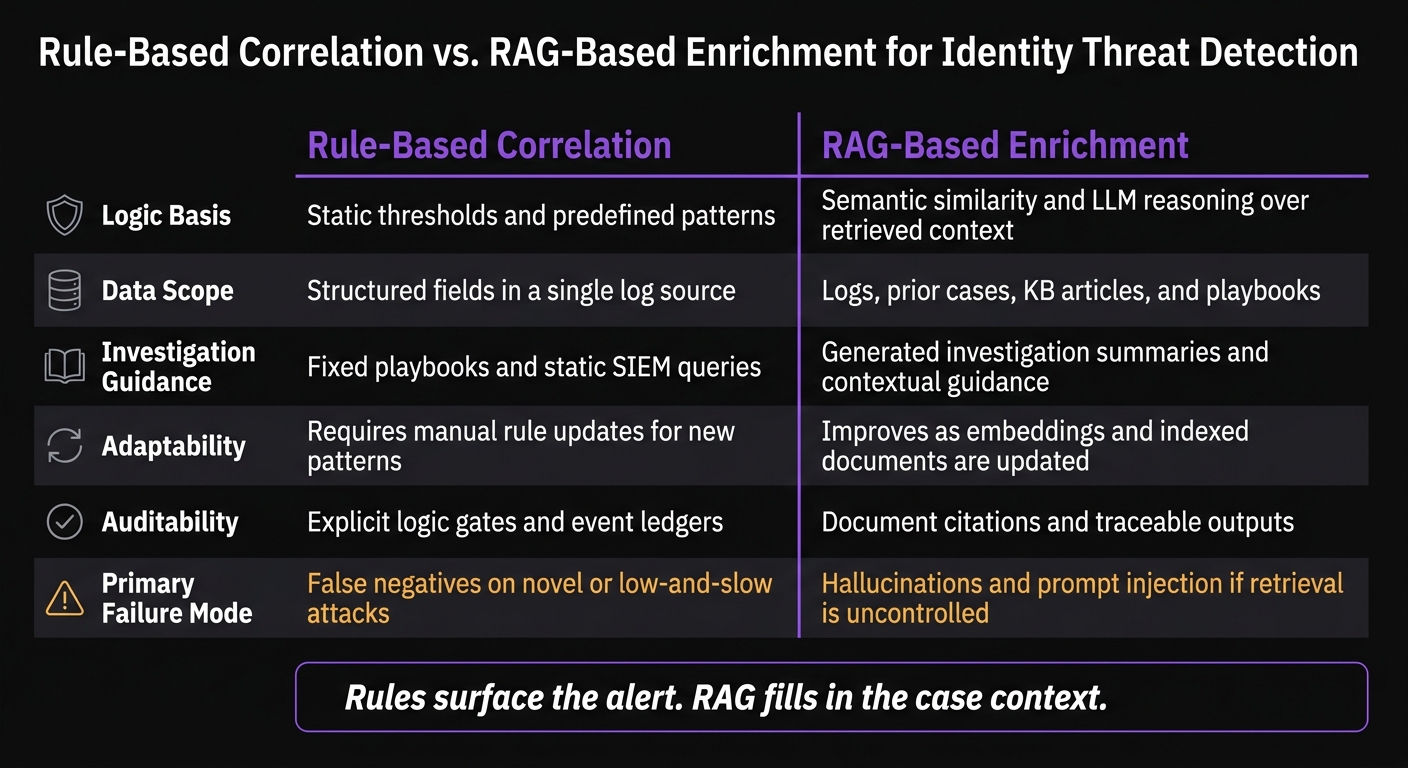
Rule-Based Correlation vs. RAG-Based Enrichment for Identity Threat Detection
Once retrieval is limited to the right analyst, the next step is protecting the data, prompts, and audit trail around that retrieval.
Securing the pipeline with Microsoft-native controls
The rule is simple: the pipeline cannot retrieve anything the requesting analyst is not allowed to see. If they drift apart, the pipeline leaks data. [5]
Get rid of long-lived secrets. Use Azure Managed Identities or workload identity federation for service-to-service calls. Then pair that with OAuth 2.0 Token Exchange (RFC 8693) so the user stays the subject and the agent stays the actor. That delegation chain helps block confused deputy access. [5]
Network isolation is not optional here. Deploy Private Endpoints and VNet integration to isolate sign-in logs, incident records, playbooks, and other sensitive pipeline resources. Use encryption at rest and in transit by default. Add an API gatekeeper to enforce security trimming, log access, and handle multitenant routing. [9]
Managing regulated identity data in RAG systems
Sign-in logs, audit events, incident notes, and playbooks sit in the top tier of sensitive data inside most organizations. Before a document is chunked and embedded, run it through Data Loss Prevention controls to redact SSNs, API keys, and other regulated identifiers. The reason is straightforward: embedding inversion attacks can recover parts of source text from vectors. [7]
Carry tenant, owner, and sensitivity metadata from ingestion all the way to the vector store. Without that metadata, the retrieval layer has no reliable way to enforce document-level access boundaries at query time. [6][10]
For regulated U.S. deployments, pin storage and processing to approved Azure regions. Log every retrieval, prompt, and tool call with agent identity, delegated user, resource, and time. [9][5][4]
Keep audit records separate from application logs, and attach classification and policy decisions. That setup maps directly to HIPAA 45 CFR 164.312 and SOC 2 CC6 controls, which gives auditors a clean, traceable chain from alert to investigation output. [8]
Comparison: RAG risks by component and mitigation strategy
Each layer of the pipeline has its own failure mode. The table below maps the main risks to direct mitigations, all of which can be implemented with Microsoft-native tooling.
| Component | Primary Risks | Mitigation Strategy |
|---|---|---|
| Retriever | Over-retrieval, unauthorized retrieval | ReBAC/ABAC, token exchange, metadata filtering |
| Vector Store | Cross-tenant leakage, embedding inversion | Tenant segmentation, Private Endpoints, encryption at rest and in transit |
| Model | Prompt injection, data leakage | System prompt hardening, input/output guardrails, Azure OpenAI Content Safety |
| Orchestrator | Confused deputy attacks, incomplete audit trails | Managed Identities, API gatekeeper, Azure Diagnostic Settings |
One risk often slips past teams because it lives between retrieval and the model call: the context-assembly window. That’s the moment when retrieved chunks are reranked and merged into the prompt. Many security tools don’t see this step at all. Add application-layer tracing, such as OpenTelemetry or framework-specific callbacks, to make that window visible and auditable. [4]
An inspection layer at the HTTP boundary between retrieval output and the model call can also apply real-time redaction. In practice, that means flagging or masking regulated spans before they reach the model, usually with less than 50 ms of overhead. [8]
With access, data handling, and audit controls in place, the next question is which identity scenarios are worth operationalizing.
Use cases and operating model for production teams
High-value identity threat scenarios for RAG
Once your event triggers are set, the next move is deciding which alerts are worth sending through retrieval. Not every identity alert needs RAG. It makes the most sense when retrieval can pull in behavior history, reputation signals, and playbook context that plain rules just can't piece together on their own.
| Scenario | Trigger | Retrieval Targets | Generation Goal |
|---|---|---|---|
| Risky Sign-in / User | Geo-velocity anomaly or new device fingerprint | Historical login patterns, IP reputation, identity graph (linked devices) | Determine if the sign-in reflects identity drift relative to the user's verified baseline |
| MFA / Password Abuse | Rapid MFA enrollment change followed by password reset | Device binding history, recent support tickets, typical behavior baseline | Assess whether the change sequence indicates an active account takeover |
| OAuth App Consent | New high-risk app permission request | App reputation data, internal data classification tags | Evaluate whether the app's requested scopes create an exfiltration risk |
| Lateral Movement | Unusual service account activity correlated with endpoint or network telemetry | MITRE ATT&CK patterns, internal identity graph, network flow logs | Map the event to specific adversary tactics and suggest SOAR actions |
Lateral movement is where RAG tends to earn its keep. When you connect an identity event with endpoint and network telemetry in real time, then map that activity to MITRE ATT&CK, you're doing the kind of cross-source reasoning static rules struggle with.
After you pick the right scenarios, treat the pipeline like a live SOC control. That means watching it, testing it, and tuning it on a steady basis.
How to run, measure, and improve the pipeline
Production teams should watch four core metrics: latency, cost, retrieval quality, and analyst impact.
On cost, RAG-based cloud threat detection runs at about $0.00376 per event with an average processing time of 4.1 seconds.[1] That’s workable at scale, but costs stack up fast if you skip caching. LLM response caching can cut API costs by up to 70% and trim latency by 75%, dropping total spend from about $10.00 to $3.00 per 1,000 requests.[3] In day-to-day ops, it helps to track cost per request in U.S. dollars, token usage, and cache hit rate as standard operating metrics.
For quality, use a self-reflective scoring loop that grades each retrieval on relevance, from highly_relevant to not_relevant, and on generation support, from fully_supported to no_support. This meta-evaluation method can improve confidence calibration by up to 13.3%.[3] Then pair that with historical incident replay. In plain English, feed past confirmed incidents back through updated prompts and guardrails to check whether your changes improve detection before anything reaches production.
The KPIs security teams usually care about most are:
- triage time reduction
- false-positive handling time
- enrichment coverage, meaning the share of alerts that show up with automated context attached
- confidence calibration
That focus makes sense. Security analysts currently spend close to one-third of their time investigating false positives.[2] A tuned RAG pipeline helps cut that load by attaching richer context during triage, when speed and clarity matter most.
Comparison: day-to-day operations vs. periodic reviews vs. architecture changes
| Activity | Focus | Cadence | Ownership |
|---|---|---|---|
| Daily Ops | Monitoring latency, error rates, and token and query cost ($); tuning retrieval similarity floors; managing cache TTL; triaging alerts | Continuous | Internal SOC / Ops |
| Monthly/Quarterly Reviews | Model performance (RAGAS scores), policy alignment (NIST 800-53), compliance audits, 14 to 21 days of representative traffic, historical incident replay | Monthly / Quarterly | Internal Security |
| Change Control | Onboarding new identity sources, refactoring for tenant isolation, hardening new pipeline windows, Semantic Kernel updates | As needed | Internal Engineering |
For alert tuning, give yourself 14 to 21 days of representative traffic first. That waiting period matters. If you skip it and start tuning alerts right away, you usually end up with noisy output and low-confidence results.
Conclusion: What a production-ready RAG identity pipeline should deliver
A production-ready RAG identity pipeline should tie every alert to evidence at the moment a decision is made. That cuts down analyst guesswork and helps teams make better calls. The key is event-driven correlation, not batch review.
For that to work, identity events need to be handled as a timeline, then used to trigger retrieval in real time. And that’s only half the job. Retrieval also needs to be identity-aware at the access layer.
In plain terms: the system has to respect the requesting user’s entitlements at query time. If it doesn’t, the pipeline has an authorization gap.
Measurement is the last piece. Teams should track:
- Time to decision
- Manual review volume
- Groundedness
- Confidence calibration
Those metrics need constant monitoring. If no one watches them over time, the pipeline will drift.
FAQs
When should RAG run on identity alerts?
RAG should run when an identity alert needs context-aware validation that goes beyond static rules. In plain English, it helps you figure out whether a chain of events points to a real threat or just another false positive.
It works best after you’ve built a strong behavioral baseline. That means pulling in real-time events, historical logs, user details, and frameworks like MITRE ATT&CK to add context to identity signals and cut down the noise.
How do you keep retrieval access-aware?
Apply fine-grained authorization at the retrieval layer, not just through app-level checks. Add identity metadata, such as security badges or access attributes, to documents in the vector index.
At query time, the retriever should use delegated authority to match the user’s identity token against that metadata. That way, the vector database returns only the content the user is allowed to see.
What metrics show a RAG pipeline is working?
Track model metrics like accuracy, precision, and F1-score, along with day-to-day system metrics such as processing latency and cost per event.
Also keep an eye on data stream telemetry. That includes vector database writes with source attribution, embedding model invocation cadence, index population rates for each connector, and authorization enforcement at retrieval time.


